American Watercolor · Watercolor
What These Autumn Watercolors Can Teach You
Three watercolors, one big lesson: let a small story anchor the season.
By Kelly Kane · November 1, 2026
Autumn tests a painter’s palette: oranges, reds, and golds, plus the quiet browns, grays, and lavenders that make them sing, all shifting with the light. Watercolor, with its transparency and glowing paper, suits the season well. Three works from the National Gallery of Art show how differently it can be handled.
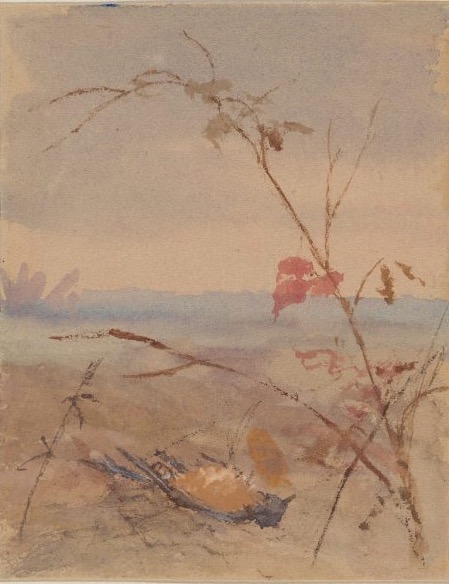
Fidelia Bridges’ Dead Yellow-breasted Bird in Autumn Landscape (1870s) is tiny, on a sheet just 3¾ by 3 inches. A bird lies on textured ground of warm browns and blues beneath tall, thin branches with only a few leaves, while the muted pinks, browns, and blues of the sky create a still, simple mood. It’s a reminder that autumn doesn’t need a blaze of foliage to be felt.
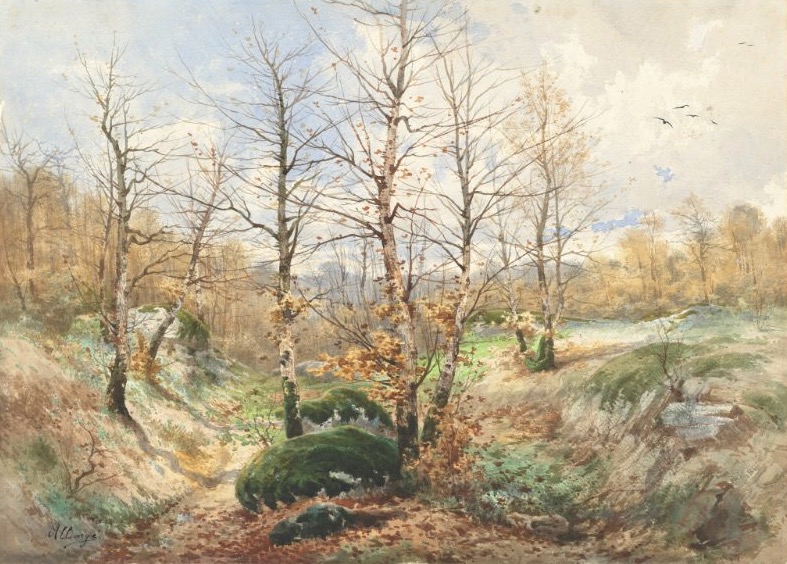
Auguste Allongé’s Autumn Landscape in the Forest of Fontainebleau (c. 1860) goes the other way, on a sheet more than two feet wide. Trees in orange, red, and sage green frame a meadow where a stream winds past grazing sheep and cows, with a town along the riverbank and water in the distance. Three men and their dogs picnic near a waterfall in the lower left, and light bursts from behind a cloud near the low sun.
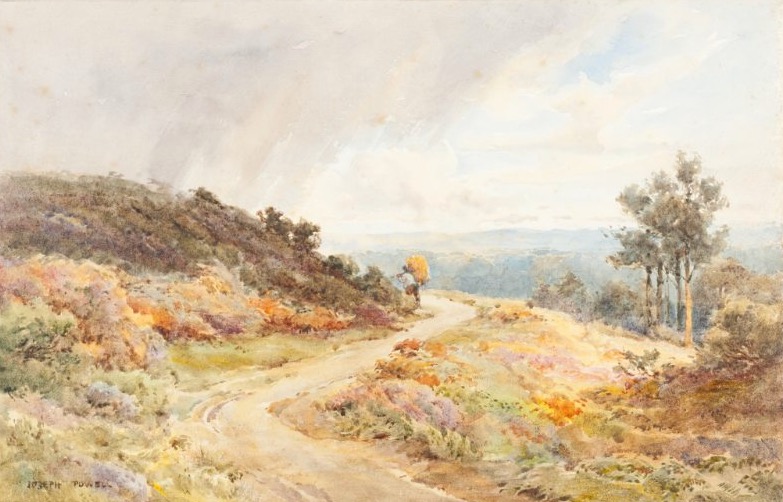
Joseph Rubens Powell’s Autumn (at top) falls between the two, at about 7 by 11 inches. A path curves over a hill toward distant blue hills, bordered by orange, red, gold, light green, brown, and lavender. A figure carrying a large yellow pack walks away along the path, and a light gray sky streaked with white and pale blue lets the foliage take center stage.
Each painter adds a small touch of life: a fallen bird, a picnic, a lone traveler. It’s a useful lesson for any painter facing a landscape full of color: let a small story anchor the season.
More watercolor, delivered.
Join the American Watercolor newsletter for artist stories, step-by-step demos, and fresh ideas to try at your next painting session. It’s free, and you can unsubscribe anytime. Sign up →